Information

Get In Touch
info@support.com

Call Any Time
+88 (123) 456 - 39

Our Location
321 Soho, New York

Coustomer Service

Please accept cookies to continue enjoying our site, we promise they're delicious.


 17 July 2026
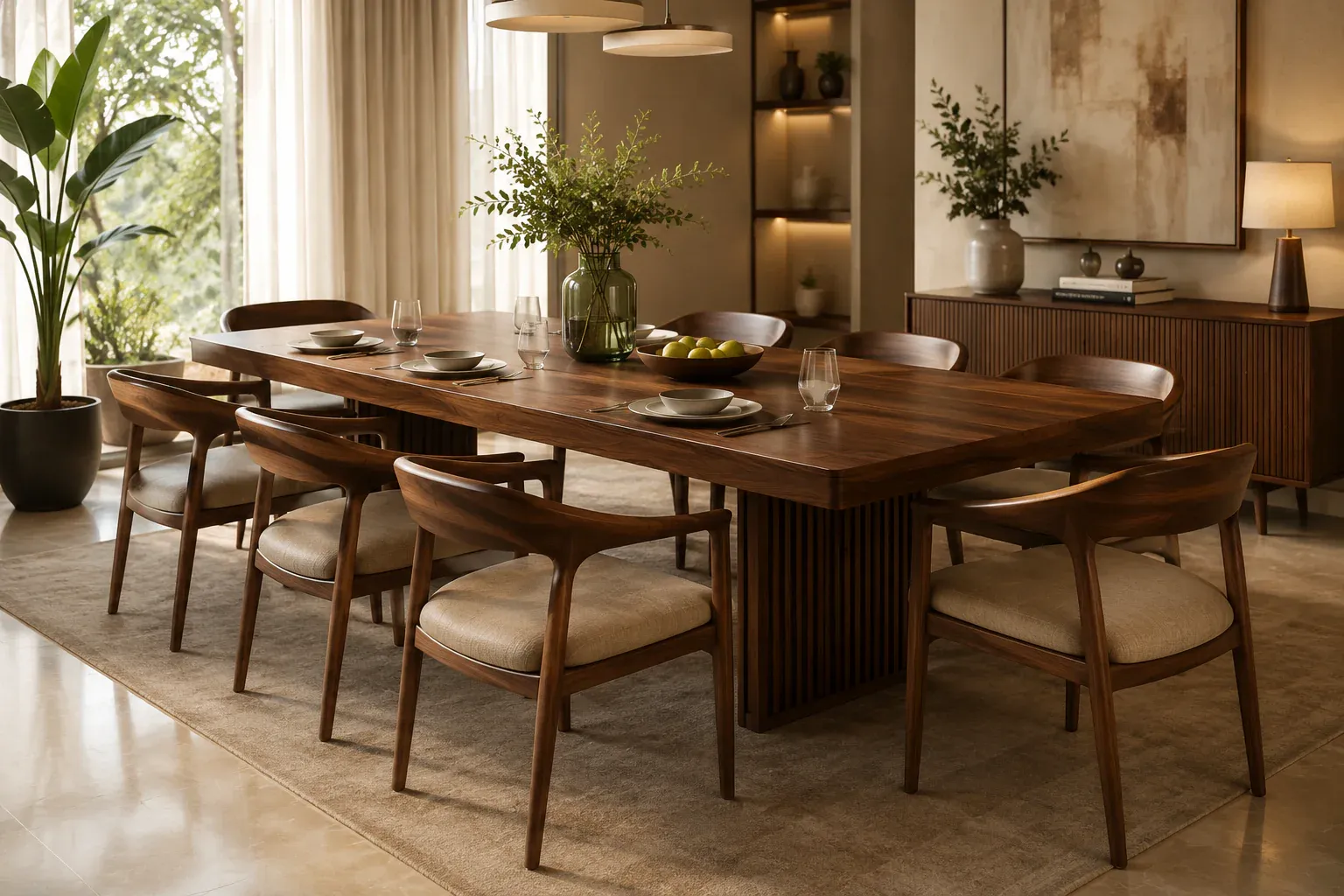
A dining table is a piece of furniture that is used daily. Meals happen there, obviously. But so do quick work calls, school projects, late-night conversations, and those moments when guests somehow gather around the dining area even when the living room is empty.
Which means choosing the wrong table size becomes noticeable very quickly.
Too large, and the room feels blocked. Too small, and every family dinner starts resembling a seating negotiation.
For buyers exploring premium handcrafted furniture, Dezaro approaches dining room furniture through craftsmanship, spatial planning, and interior expertise.
The result feels less like “buying furniture” and more like designing a room properly from the beginning.
Because good furniture should not constantly remind you it exists. It should simply work.
The first thing most people check is whether the table physically fits inside the room. Designers usually think differently. They calculate how people move around it.
That is where dining table dimensions become important.
A table may technically fit inside a room, but if chairs cannot be pulled back comfortably, or if people cannot walk behind someone seated, the space will still feel wrong.
A useful starting point is this:
| Seating Capacity | Recommended Size in Inches | Recommended Size in Feet | Best For |
|---|---|---|---|
| 4 Seater | 36–48 L × 30–36 W × 28–30 H | 3–4 ft × 2.5–3 ft | Apartments, small families, breakfast corners |
| 6 Seater | 60–72 L × 36–40 W × 28–30 H | 5–6 ft × 3–3.3 ft | Medium families, regular dining, occasional guests |
| 8 Seater | 78–96 L × 38–44 W × 28–30 H | 6.5–8 ft × 3.2–3.6 ft | Larger homes, open dining spaces, frequent hosting |
These are general size guidelines. The final choice still depends on the room layout, chair size, table shape, and how the dining area is used every day.
Most dining tables sit around 28 to 30 inches high. This height works comfortably with standard dining chairs and allows enough legroom for everyday dining.
It is one of those details people rarely think about until something feels slightly wrong.
A table that is too high can make dining feel stiff. A table that is too low can make seating uncomfortable. The right height keeps the experience natural, especially when the chairs and table are bought separately.
Circulation clearance refers to the free movement zone around furniture. The space in dining spaces is ample enough for chairs to pull back comfortably and provides adequate room for walking behind sitting diners.
Clearance is vital. Rooms can feel cramped or small if not enough space has been left available.
So, being mindful of the clearance space for an Indian home is a smart move. We are all well aware that dining spaces tend to have variable seating arrangements for get-togethers and festivals rather than static everyday setups.
And honestly, that flexibility is way more powerful than catalogue photographs might lead you to believe.
A dining table size for a 4 seater arrangement is excellent for small families, apartments, studio layouts and tiny urban residences. The problem here is about blending seated comfort with an open feel.
Rectangular four-seater tables typically work better in narrow spaces because they align efficiently with room geometry. Round tables, however, soften visual structure and create more conversational seating arrangements.
Human perception responds strongly to directional lines. Rectangular tables create linear visual movement, making rooms appear longer and more structured. Circular tables interrupt those directional edges, which psychologically softens the space and creates a more relaxed atmosphere.
It’s subtle. But the room feels different almost immediately.
Chair proportions also need to be carefully addressed when considering a dining table size for 4 seater configuration. Upholstered chairs take up more visual and physical space than thinner wooden designs, impacting circulation and comfort overall.
If you are still deciding between shapes and finishes, our guide to modern dining table design ideas can help you understand which style suits your home better.
The 6 seater dining table remains one of the most versatile choices for modern homes. It is big enough for daily family use but still leaves room for extra seating when guests visit.
However, dimensions alone do not guarantee comfort.
Structural design changes seating usability.
Table leg positioning significantly affects functional seating space. Thick corner legs can reduce usable edge width because chairs cannot tuck inward naturally. Tables with recessed bases or pedestal-style supports allow increased usable space for continuous and flexible seating without increasing the footprint of the tables themselves.
This is also why many dining tables are much more comfortable to sit at, even when they have the same outside dimensions as less comfortable types.
Dezaro combines high-quality craftsmanship with form and function to create beautiful but very functional dining furniture.
When to Get an 8 Seater Dining Table Size? An 8 seater dining table size is perfect for larger houses, open dining spaces, hospitality-inspired décor, or families that party often.
But bigger tables have a different problem: visual weight.
A huge dining arrangement might easily overwhelm the room if the proportions of the surroundings aren’t balanced properly. The size of dining tables also depends on the arrangement of lighting, ceiling height, flooring texture and surrounding furniture.
This is when Dezaro's interior design experience really pays off. Their team works across residential, hospitality, and industrial projects, helping clients understand how furniture interacts with complete spatial layouts instead of selecting pieces individually.
Sometimes that guidance prevents costly mistakes later. Sometimes it simply saves time. Usually both.
The best handcrafted furniture in the luxury range is rarely distinguished by appearance alone. The true worth is in the quality of construction, the behaviour of materials, and the structural performance over the long period.
If material specifications vary across collections, buyers should verify details directly through product consultations or collection descriptions. That remains the most reliable approach when evaluating premium furniture claims.
For customers searching for a dependable dining table for Indian homes, this level of craftsmanship matters because dining furniture experiences constant real-world use — movement, weight distribution, cleaning cycles, and years of everyday interaction.
Well-crafted furniture does something quieter. It settles naturally into the home and continues working comfortably year after year without demanding attention.
Choosing the right dining table size is not only about choosing between 4, 6, or 8 seats.
It is about understanding the room, the movement around the table, the way your family uses the space, and the kind of atmosphere you want to create.
A 4 seater dining table can make a compact home feel warm and efficient. A 6 seater dining table can balance everyday comfort with occasional hosting. An 8 seater dining table can bring scale, presence, and a sense of occasion to larger homes.
The right table does not fight the room.
It belongs there.
And when it does, dining becomes easier, gatherings feel more natural, and the furniture quietly does what good furniture is supposed to do.
It simply works.
Most dining tables are around 28 to 30 inches high. This height works well with standard dining chairs and gives enough legroom for everyday dining.
A 4 seater dining table usually works well between 36 and 48 inches in length. Round 4 seater tables usually work well around 36 to 44 inches in diameter.
A 6 seater dining table usually works well between 60 and 72 inches in length, with a width of around 36 to 40 inches.
An 8 seater dining table usually works well between 78 and 96 inches in length, with a width of around 38 to 44 inches.
Keep at least 36 inches of clearance around the dining table. For more comfort, especially in larger dining rooms, 42 to 48 inches works better.