Information

Get In Touch
info@support.com

Call Any Time
+88 (123) 456 - 39

Our Location
321 Soho, New York

Coustomer Service

Please accept cookies to continue enjoying our site, we promise they're delicious.


 17 July 2026
The sofa is the one piece of furniture in a home that almost everyone has an opinion about before they buy it — and a very different opinion six months after.
Too deep and you perch on the edge rather than sink in. Too shallow and your legs have nowhere to go. The wrong fabric shows every mark from the first week. The wrong size and the living room shrinks around it.
Choosing a sofa well takes maybe an hour of thought upfront. Getting it wrong takes years to forget. Here's what that hour of thinking should cover.
This sounds obvious. Most people skip it and regret it.
The sofa needs to fit the room, but it also needs to fit the life of the room — how people move through it, where the other furniture sits, how far the sofa sits from the TV or coffee table.
The numbers that matter:
Leave at least 45–50 cm (18–20 inches) between the front of the sofa and the coffee table — enough to rest your feet comfortably without the table being out of reach. Leave at least 90 cm (36 inches) of clear walkway behind the sofa. In open-plan living areas, a sofa often serves as a room divider — in that case, you need clearance on both sides.
Room size as a starting point:
These are starting points — always verify against your actual room dimensions before committing.
One thing people consistently forget: the sofa has to get into the room first. Measure your front door, any hallway corners, lift dimensions if applicable, and the door to the room itself. Check the largest single dimension of the sofa against your narrowest access point. A sofa that can't make it through the door is a problem no amount of good taste solves.
Most people compare sofa widths. The measurement that actually determines how a sofa feels to sit on is the seat depth — the distance from the front of the cushion to the back of the seat.
It typically falls between 50 cm and 65 cm (20–26 inches).
The Seren Sofa has a 24-inch (61 cm) seat depth — on the deeper, more enveloping end, designed for a relaxed low-profile feel. If you prefer a more upright sitting position, add a firm cushion at the lower back.
Check this spec before any other dimension. It determines the experience of the sofa more than almost anything else.
2-seater (loveseat) — 140–180 cm / 55–71 inches Works as a standalone sofa in compact rooms or as a secondary seat paired with a larger sofa or a pair of armchairs. Seats 2 adults comfortably, 3 if they know each other well. Suits studio apartments, home offices, or bedroom sitting areas.
3-seater — 190–220 cm / 75–87 inches The most versatile size for most living rooms worldwide. Seats 3 adults properly, or 2 adults with space to stretch out. Fits most standard living rooms without crowding the space. If you're buying one sofa and one sofa only, this is almost always the right call.
3.5-seater or large 3-seater — 220–250 cm / 87–98 inches For households of 4 or more, or living rooms where the sofa is the primary seating for family evenings. Generous without requiring a sectional. Worth choosing if you regularly host.
Sectional / L-shape Suits large, open-plan spaces where the sofa anchors a defined seating zone. Requires significantly more floor space. Before choosing, confirm which direction the chaise extends (left or right when you're facing the sofa from the room) — getting this wrong is one of the most common and most frustrating furniture mistakes.
Fabric is where most buyers focus last. It should be considered early—because it affects not just appearance but daily maintenance and how long the sofa looks good.

Velvet is the most sought-after finish in premium sofas right now. Velvet is softer than it looks, holds colour richly, and photographs beautifully. In everyday use, it shows sitting imprints (which brush out easily), picks up pet hair, and needs regular vacuuming. It works best in lower-traffic living rooms or well-ventilated, climate-controlled spaces. The Seren Sofa is wrapped in premium velvet — the kind of finish that makes the whole room feel more considered.
Linen and linen-blend: relaxed, breathable, and tactile. Linen-blend fabrics are more durable than pure linen and hold up better to daily use. They wrinkle naturally — which reads as effortless in some rooms and untidy in others, depending on how the sofa is styled. Works well in homes with natural materials throughout: wood, stone, and rattan.
Performance fabric (polyester-blend or microfibre) The practical choice for households with children, pets, or simply a lot of daily use. Stain-resistant, easy to wipe, holds up without visible wear. Less luxurious in hand feel than velvet or linen, but far easier to live with. Worth prioritising if the sofa will be used heavily every day.
Boucle A textured loop-pile fabric that has become one of the most popular sofa finishes in contemporary interiors. Warm in appearance, interesting in texture, and more durable than it looks. Hides minor marks better than velvet. Works especially well in neutral, warm-toned rooms.
Leather Genuine leather develops a patina over years — it gets more characterful with age, not less. It's easy to wipe clean, doesn't trap dust or pet hair, and suits both classic and contemporary interiors. Faux leather (PU or leatherette) offers a similar look at a lower price point but doesn't age as gracefully and can crack over time.
Low-profile / contemporary Clean lines, low back, minimal or absent arms. Feels modern and open. Works particularly well in rooms with standard or lower ceiling heights — a tall-backed sofa in a low-ceilinged room creates visual pressure. The Aeris Sofa and Seren Sofa both follow this approach — sculptural in form, low and enveloping, designed to belong in the room rather than dominate it.
Mid-century modern tapered wooden legs, slightly firmer cushions, defined arms. One of the most enduring sofa styles precisely because it works across so many interior aesthetics — earthy and warm, cool and minimal, eclectic or restrained.
Chesterfield / classic rolled arm Button tufting, high rolled arms, a formal silhouette. Best in larger, traditional interiors where the proportions can carry the weight of the style. Can feel heavy in compact or minimal rooms.
Modular Individual sections that reconfigure to suit the space. Practical for open-plan homes, rooms that serve multiple purposes, or people who move frequently. Requires more planning upfront — modules need to work as a composition, not just as parts.
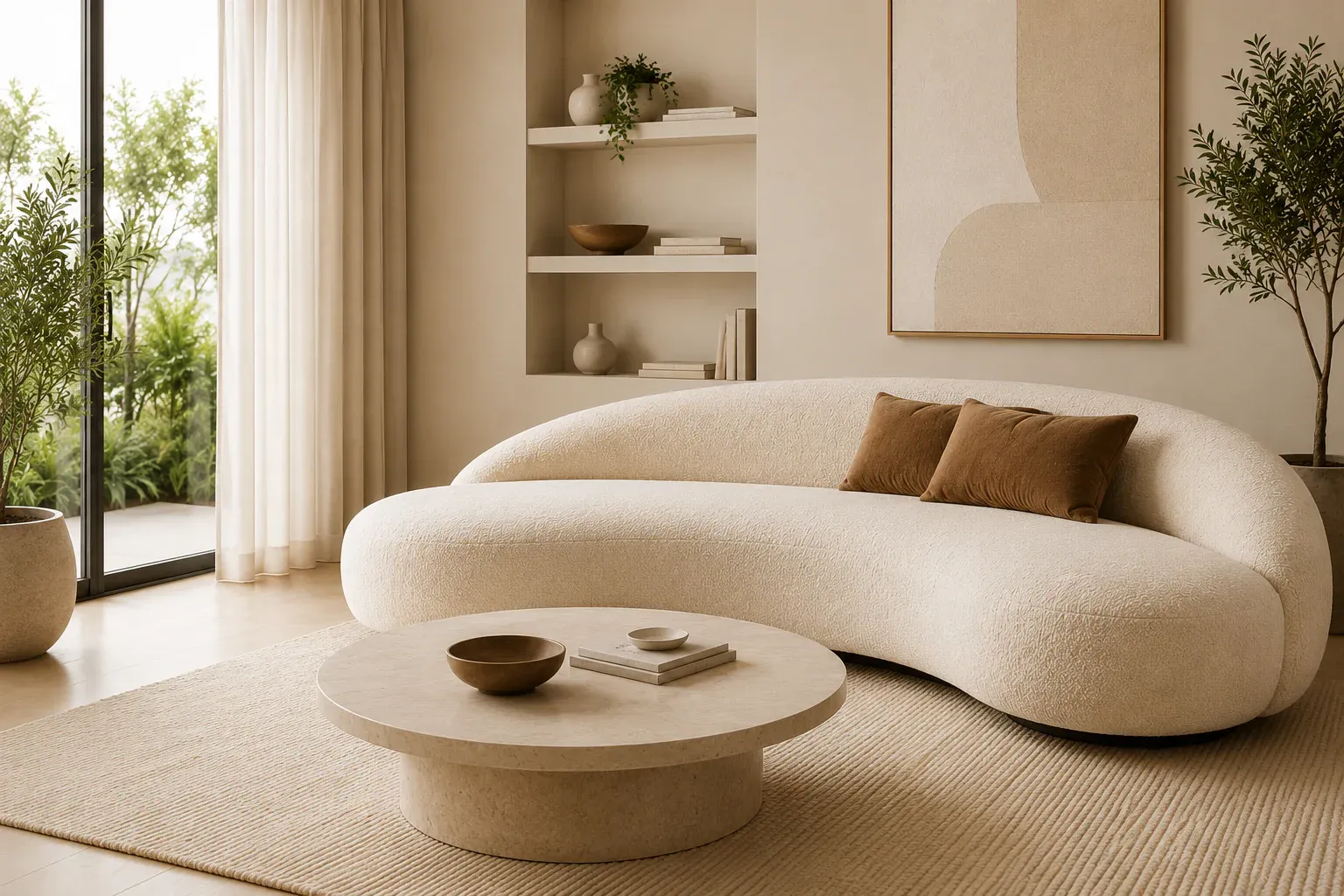
Curved Sofas with a gently curved back or rounded silhouette have grown significantly in popularity in recent years. They soften the geometry of modern rooms and work particularly well in open-plan spaces where the sofa is visible from multiple angles.
Frame: Solid hardwood frames last decades. Softwood or engineered board frames last years. Ask specifically — the word "wood" in a listing tells you less than you'd think.
Cushion fill: High-density foam (30–40 kg/m³) holds its shape for years. Low-density foam compresses and the sofa begins to sag within 18–24 months. Feather-and-foam combination cushions are extremely comfortable but need regular plumping to maintain their shape.
Seat height: Standard sofa seat height is 40–45 cm (16–18 inches). Lower profiles (35–38 cm) look elegant but can be harder for older adults or anyone with knee or hip issues to get up from comfortably.
Leg style and floor type: Wooden legs on hard floors can scratch if not felt-padded. Metal legs on thick-pile carpet can sink unevenly. Worth checking before delivery.
Return and delivery policy: Confirm whether the sofa arrives flat-packed or fully assembled, what the return window is, and whether white-glove delivery (room placement and packaging removal) is available. For a piece this size, it matters.
| Living Room Size | Recommended Sofa | Width |
|---|---|---|
| Small (under 120 sq ft / 11 sq m) | 2-seater sofa | 150–175 cm (59–69 in) |
| Medium (120–180 sq ft / 11–17 sq m) | 3-seater sofa | 200–220 cm (79–87 in) |
| Large (180–250 sq ft / 17–23 sq m) | Large 3-seater sofa | 220–250 cm (87–98 in) |
| Open-plan / Very Large | Sectional sofa | 270 cm+ (106 in+) |
A sofa is the piece of furniture you'll use more than any other in your home. You sit on it every evening. Guests sit on it when they visit. It anchors the living room visually and sets the tone for everything around it.
It's worth taking the time to get this right — not overthinking it, but thinking it through properly. Measure the room. Check the seat depth, not just the width. Choose a fabric that suits how you actually live, not how you imagine you'll treat it.
The right sofa doesn't just fill the room. It makes the room. Once you've found it, pair it with an accent chair or lounge chair to complete the seating arrangement.